DeepSeek SuperAgent is a public coding-agent research prototype built around repository work, rather than a new language model. The deepseek-ai GitHub repository was created on October 31, 2026; its initial commit is dated the same day. The authors explicitly distinguish the prototype from an official DeepSeek product and warn that it is not ready for production. That boundary matters when interpreting reports about a new autonomous coding system. Repository metadata, initial commit, README
DeepSeek SuperAgent facts at a glance
| Item | Verified detail |
|---|---|
| Public repository | deepseek-ai/dsh-superagent-prototype |
| Repository creation | October 31, 2026, according to GitHub metadata |
| Status | Research reference prototype |
| Runtime | A bundle for DeepSeek Harness |
| Initial scope | One GitHub repository, with optional Feishu integration |
| License | MIT |
These details come from the repository metadata, README and license. The date identifies the public repository record; it does not establish the time of a separate product announcement.
How the DeepSeek SuperAgent workflow creates tickets
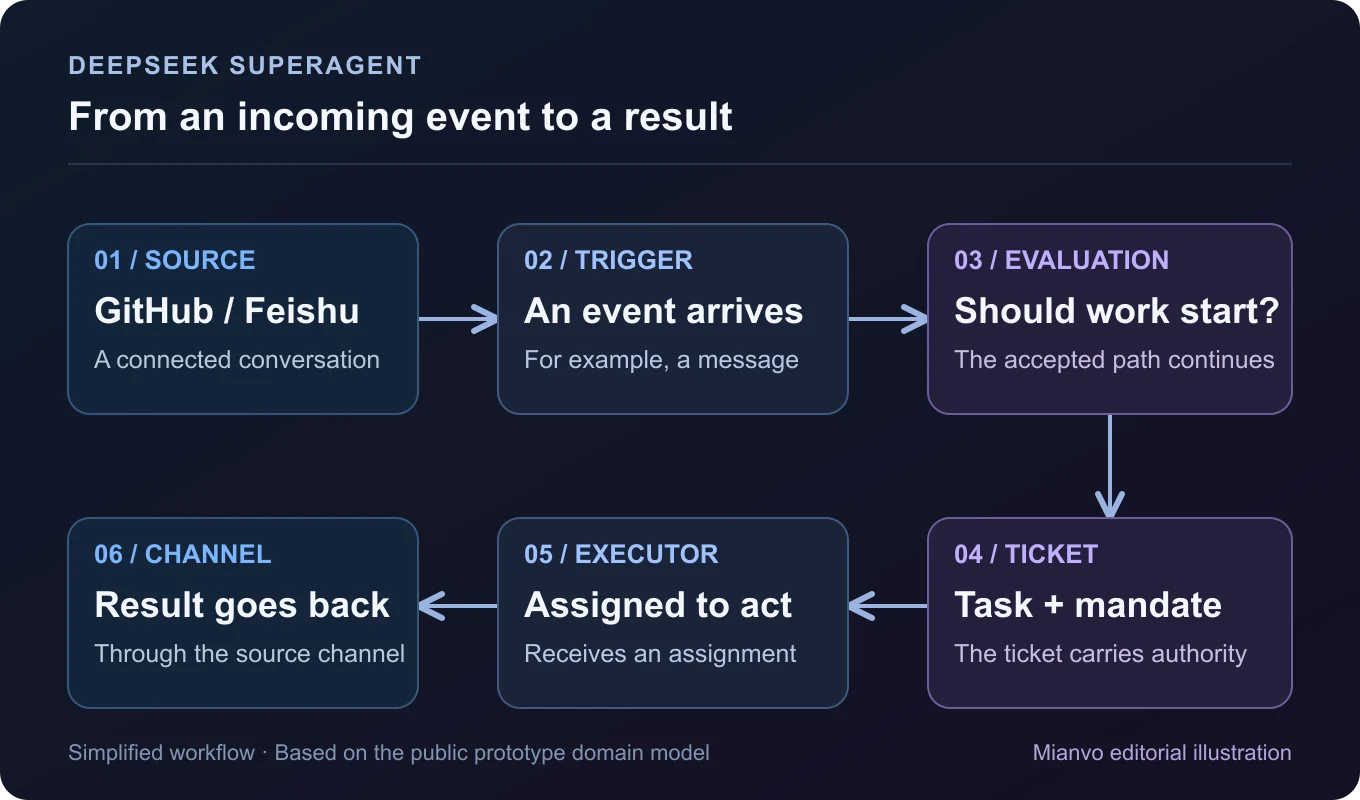
The domain documentation describes an event-driven workflow. A connected source produces a trigger, such as a message. Evaluation decides whether it should start work. An accepted request becomes a ticket with a mandate defining its authority, and an assignment sends that ticket to an executor. Results return through the source's communication channel. Domain model
Source: DeepSeek GitHub documentation
Related conversations can supply context without automatically routing new work. The domain rules also specify that accepting the same trigger twice creates one ticket. These are useful distinctions for a system that receives repeated notifications and follow-up messages. Domain rules
Our reading is that the interesting unit here is the authorized task, with a traceable origin and outcome. For an engineering team, that offers a more concrete evaluation target than asking whether an agent feels generally autonomous.
DeepSeek SuperAgent authorization and proactive behavior
The authorization guide separates explicit requests from inferred opportunities. An allowed person directly addressing the agent can request work. Other messages are handled according to source policy, admission settings and written rules. Messages and quoted documents cannot themselves change host-enforced permissions. Authorization guide
Inferred work has three modes: off, observe and auto. The default observe mode assesses candidates and records when it would have accepted them, while starting no inferred work. Explicit requests remain available in every mode. Automatic acceptance requires a positive assessment matching an enabled rule. Acceptance modes
This makes a practical first experiment possible: examine the recorded decisions before enabling proactive execution. Our suggested question is whether the selected work deserves attention, rather than how many tasks the system can discover. An incorrect choice of task can consume review time even when the resulting code is technically valid.
DeepSeek SuperAgent execution and the review boundary
Each ticket receives its own executor session and directory. A preparation command can create a checkout with git worktree; without preparation, the worker begins in an empty directory. Worker slots are limited by configured concurrency, and a slow preparation affects its own ticket rather than blocking every launch. Execution guide
The documented merge behavior deserves careful reading. Auto-merge is governed by delivery instructions, while the host has no merge-specific decision logic. The default instructions restrict it to a ready ticket pull request with current required approvals and fewer than 200 added-plus-deleted lines. Auto-merge is not enabled for the agent account by default: delivery requirements must name a separate account CLI, or a person must merge the change. The guide recommends GitHub branch protection to enforce approvals, and allows teams to require manual merging. Merge behavior
A separate directory should therefore be understood as work organization. It does not establish that a change is correct, or that the operating environment is isolated.
What setting it up involves
The official setup workflow is designed for a coding agent to follow with an operator. It first gathers choices about sources, repository, agent identity, authorized requesters and execution. It then presents the complete plan and waits for confirmation before carrying it out. Secrets are entered by the operator through their own terminal rather than supplied in chat. Setup instructions
The deployment guide calls for a dedicated DeepSeek Harness profile, an agent GitHub user account and a configured model provider. Feishu is optional. It lists Node.js, pnpm, Git, Python, tmux and GitHub CLI prerequisites, and supports repositories on github.com rather than GitHub Enterprise Server. Deployment prerequisites
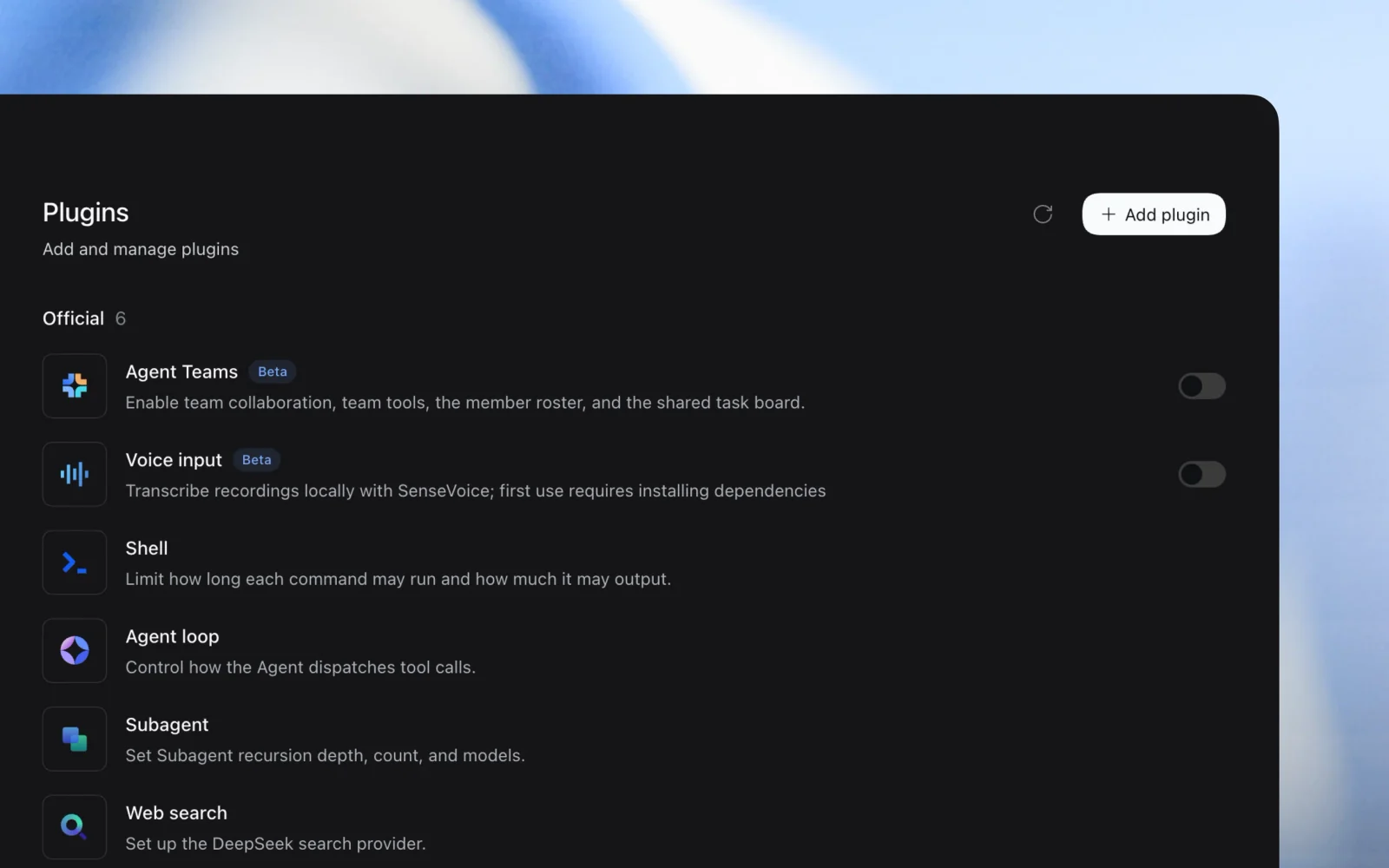
The prototype runs as a bundle inside DeepSeek Harness. The official image below shows that host application's plugin manager, not the SuperAgent prototype's custom web panel.
That is a developer-operated installation with several dependencies. For a small trial, our suggestion is to use a disposable repository and define what a successful change must demonstrate before connecting everyday team work.
For example, choose one reproducible defect with a failing check and a small expected correction. Record which message started the ticket, inspect the proposed diff, run the project’s checks, and review the final reply. Then try an ambiguous request that should require a question. These are suggested evaluation exercises, not reported test results. Together, they examine both delivery and restraint: completing an appropriate change is useful, while recognizing a missing requirement can prevent unnecessary work. Keeping the trial narrow also makes it easier to identify whether a problem came from routing, repository preparation, implementation or review.
Operating-system access is a real limitation
The deployment documentation states that router and worker presets run with broad access as the operator's operating-system user. Account wrappers select credentials but do not isolate the process; workers can execute programs by path and read the operator's home directory. The guide recommends a dedicated operating-system account for isolation. Permissions and isolation
The distinction between permission policy and process isolation is central to evaluating this prototype. Restricting who may request a ticket addresses one problem; limiting what the running process can access addresses another.
Supervising DeepSeek SuperAgent with prompts and a panel
Teams can edit communication, ticket-scope and delivery requirements, add skills, and override built-in prompt sections. Changing those instructions does not change the permission gate, mandates, tool checks or account wrappers enforced in code. Prompt configuration
The web panel appears in the DeepSeek Harness sidebar. Its overview prioritizes tickets needing action and system problems; other tabs expose sources, triggers, evaluation decisions, execution and settings. Ticket details show the originating trigger, decision, scope and policy version. Panel guide
For an evaluation, those records could help answer a useful question: why did this work start, and what does the agent need now? That is our proposed review method, not a claim that we tested the panel or verified a production deployment.
Why the design is worth examining
The project's philosophy treats human attention as a limited resource. It calls for short acknowledgements, quiet execution, messages when a result or decision is useful, and a narrow initial allowed list. It also asks operators to own the messages posted under the agent's accounts. Operating philosophy
Our analysis is that these choices shift the evaluation from raw activity to useful handoffs. A team could track whether requests were interpreted correctly, whether reviewers received enough evidence, and how often people had to intervene. Such measurements would say more about suitability for that team than repository popularity alone.
Limits and frequently asked questions
Is DeepSeek SuperAgent a supported product?
The README labels it a research reference. Published code differs from the internal system and accompanying design article; some article ideas remain unimplemented. Treat that broader design separately from the prototype. Prototype boundary
Does it require a particular DeepSeek model?
The deployment guide says it uses the Harness profile's default model unless evaluation or execution settings specify another. A model provider must be configured. This is software orchestration around a provider, not a newly released set of model weights. Model configuration
Has Mianvo benchmarked it?
No. This article examines the published documentation and repository record. It makes no comparative speed, coding-accuracy or operating-cost claim. A useful next step for an interested developer is to inspect the implementation and test a bounded task with explicit acceptance criteria.