
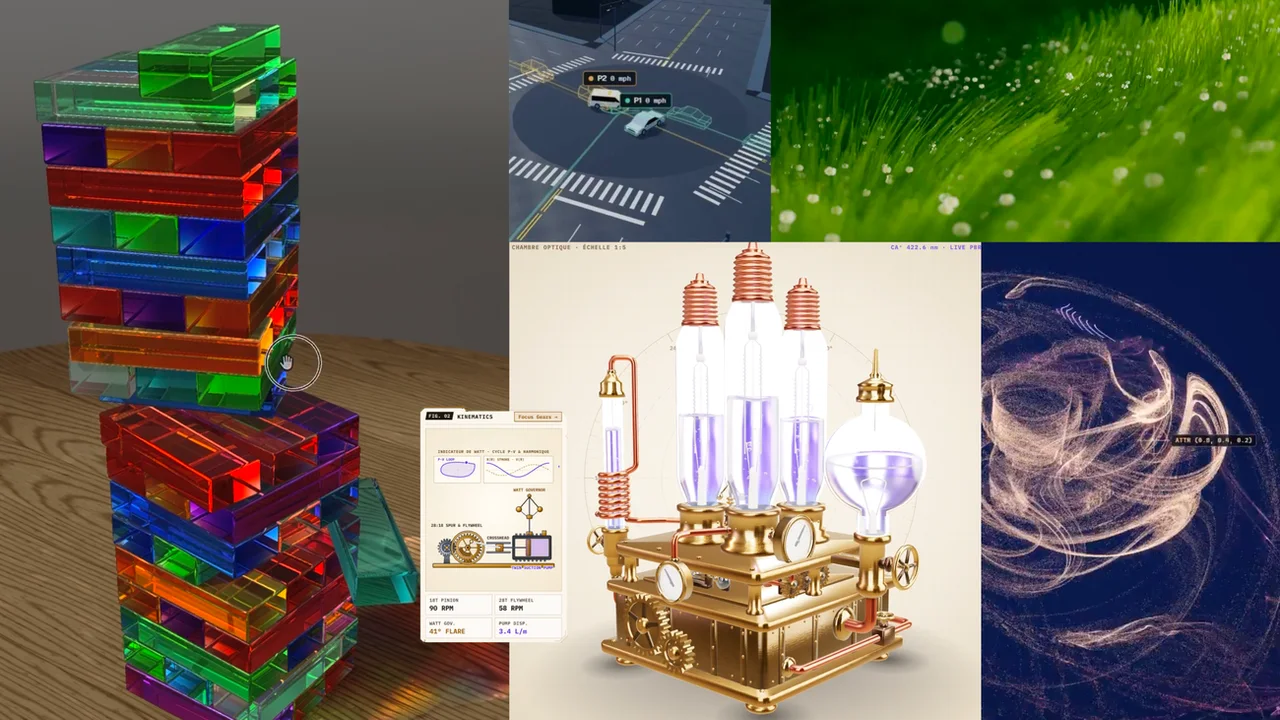
Google’s November 17 Gemini 4 Carbon showcase focuses on things people built with the model, rather than a new benchmark table. The five featured projects span visual simulations, a glass-block game, public-data tools and an interactive optics laboratory. They illustrate a useful creative category: software that generates a visual experience a viewer can explore.
Cover: Google’s official collage of the featured Carbon projects.
From a generated scene to an interactive one
The examples include a wind-driven meadow, a large particle simulation and a game whose glass pieces react to movement. Another builder turned scattered records into interactive tools; a reference image was used to develop a historical laboratory scene. These are Google-selected demonstrations, not independent measurements of reliability, physical accuracy or development time.
The difference from a finished video is important. An interactive scene can respond to a viewer, but it also has to run correctly on the device displaying it. A short demonstration may look convincing while leaving questions about controls, frame rate, loading time and behavior on a phone.
Carbon’s broader release came a week earlier
The November 10 availability announcement positions Carbon for complex technical projects and extended reasoning. Google describes multi-step coding, debugging and scientific work, while continuing to position Argon for many more routine assignments. The November 17 post is a follow-up showcase, not the date Carbon first became broadly available.
Google lists paid developer and enterprise access, together with access for Google AI Ultra subscribers in supported products. Model access in an app and access through a developer API are separate arrangements; readers should check the route they intend to use before starting a project.
The next useful question is what survives inspection
For a creative prototype, an attractive first frame is only the beginning. A productive review can ask whether the controls work after repeated use, whether the scene remains responsive at a smaller viewport and whether important details survive when the camera changes.
A creator seeking a finished, shareable clip may instead prefer a video creation workflow. A creator making an interactive installation or playable scene has a different deliverable. Carbon’s showcase is most informative when those outcomes are kept distinct.