Mianvo
    CreateToolsTemplatesModels
  • AI NewsPricing
Mianvo

A new space for video, image and audio.

Tools
VideoImageAudio
Explore
TemplatesModelsCommunityAI NewsBlog
Account & Support
My CreationsCreditsBillingAbout Mianvosupport@mail.mianvo.com
AI & AGENT DOCS · LLMS.TXT

Ask ChatGPT, Claude, Perplexity, Google AI or Grok about Mianvo.

© 2024 Mianvo, All rights reserved
PrivacyTermsAcceptable Use
CreateTemplatesInspirationCreationsMe
All AI news
Models

IBM Granite Time-Series Models Come to Confluent’s Streamhouse

IBM and Confluent bring Granite time-series models into Apache Flink, where teams can forecast streams and detect anomalies with SQL on CPUs.

MianvoPublished Nov 18, 2026
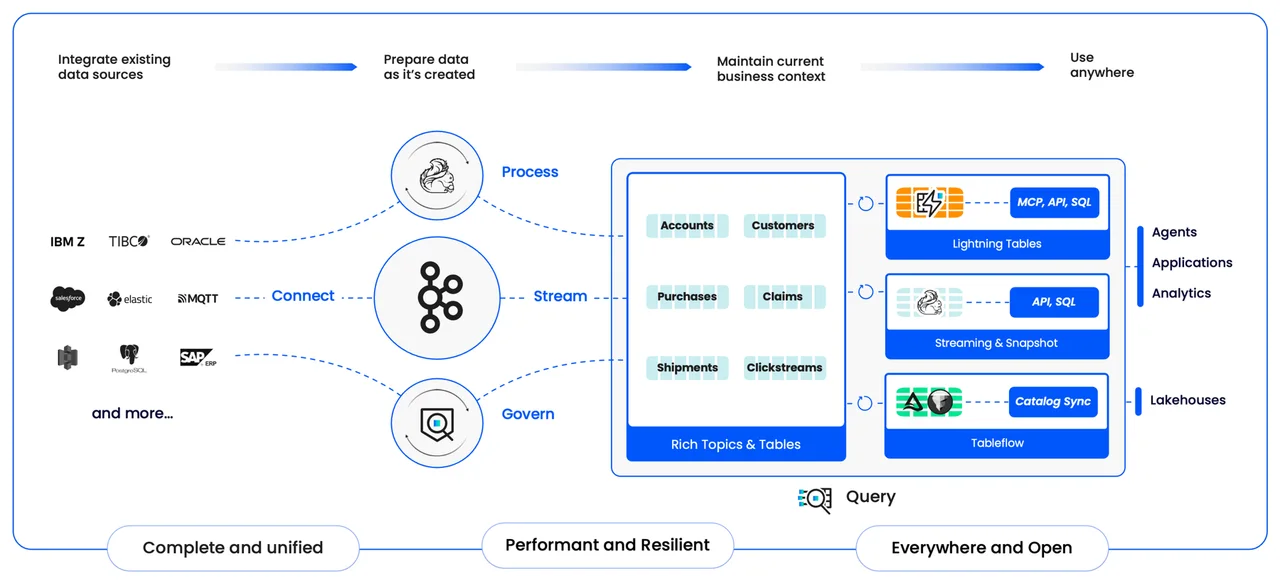
IBM Research illustration accompanying the Granite time-series Streamhouse announcement

IBM Research announced on November 18 that its Granite time-series models can run natively in Confluent’s streaming platform. The integration puts forecasting and anomaly detection close to the events applications are already processing in Apache Flink. IBM says these models run on CPUs, with managed access in Confluent Cloud and an on-premises option through Confluent Platform for Apache Flink.

A forecast as part of the stream

A sensor reading or an hourly sales count used to reach a model through a separate batch pipeline in many workflows. With the integration, Flink SQL can call forecasting or anomaly detection on a recent sequence. The forecast or alert can travel onward alongside the data that produced it.

IBM describes AI_FORECAST and AI_DETECT_ANOMALIES in its examples. One retail scenario forecasts demand across stores and products, then passes that estimate to an application that already knows the inventory level and replenishment rules. A change to inventory still depends on those rules and the operator’s judgment. IBM presents these scenarios as illustrations.

Four questions to ask before a rollout

  • Is each observation timestamped consistently, including late events and missing values?
  • How much history does the model need for the chosen horizon?
  • Can the team compare predictions against a simple baseline before relying on alerts?
  • Who reviews forecasts that would trigger an expensive or irreversible operation?

Teams can start by recording predictions without acting on them. Comparing misses and false alarms with the current workflow gives a clearer view of whether moving forecasting into the stream changes a decision in time.


Sources

  • IBM Research’s Streamhouse announcement
  • Granite time-series model code and notebooks

In this story

A forecast as part of the streamFour questions to ask before a rolloutSources

Keep reading

A plane over water in the flight simulator built by Inkling 2 Mini, with a laptop visible in the corner
ModelsNEW

Inkling 2 Mini Brings Image-to-Code Tasks to a Local Laptop

Thinking Machines Lab’s new open-weight model reads sketches and screenshots. Its roughly 20 GB download can run on an Apple silicon Mac with 32 GB of memory.

Nov 22, 2026
OpenAI’s official launch artwork for GPT-6.2 Astra and GPT-6.2 Sol
Models

GPT-6.2 Astra and Sol Arrive in Work, Codex and API

OpenAI introduces GPT-6.2 Astra and Sol for professional and everyday work. See where they are available and what their text and image capabilities mean.

Nov 18, 2026
Liquid AI's official LFM3-VL-2B robotics demonstration showing a robot arm placing a cube in a tray
Models

LFM3: Liquid AI Releases Six Models for Local AI

Liquid AI releases LFM3, six compact models for local agents, vision, audio and decisions. Compare model access, context limits, licensing and deployment.

Nov 2, 2026