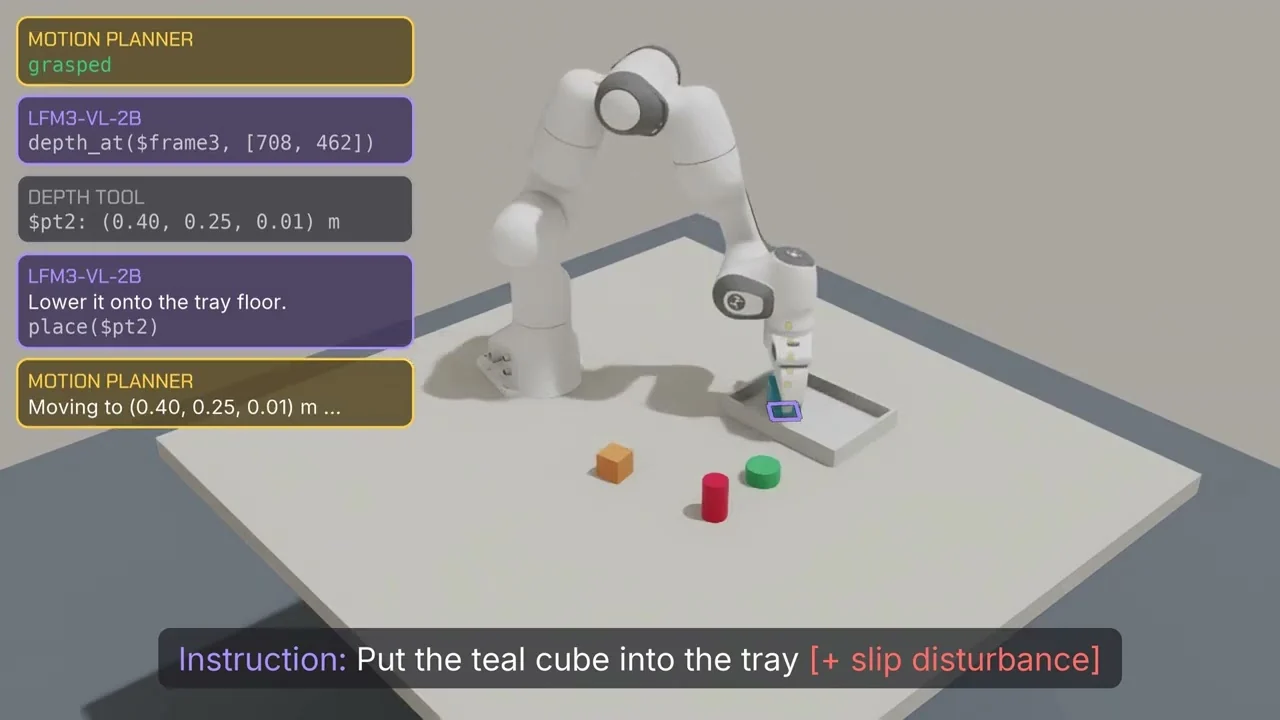
Liquid AI announced LFM3 on October 27, 2026, introducing six compact models for text, vision, audio, combined media and structured decisions. The release brings those tasks onto a shared foundation while keeping separate checkpoints for different applications. Its central proposition is specialization: choose a small model for the inputs and outputs a job actually needs, then adapt it. The official announcement links downloadable weights and customization examples.
For developers following LFM3-Omni, the important distinction is where it sits in that family. Omni combines visual and audio understanding with spoken responses; the other variants make different tradeoffs. A voice assistant, document reader and routing classifier therefore have different starting points.
LFM3 release facts and the six variants
The table summarizes each checkpoint's own documentation. Context limits include input and output where the generative cards specify this; they are capacities, not promises of equal accuracy throughout the window.
| Model | Documented inputs | Result | Context |
|---|---|---|---|
| LFM3-1.7B | Text | Generated text and tool calls | 256K |
| LFM3-VL-2B | Text, images, video | Generated text | 128K |
| LFM3-Audio-2B | Text, audio | Text, speech, or both | 32K |
| LFM3-Omni-2B | Text, images, video, audio | Text, speech, or both | 32K |
| d1-2B | Text, images, video | Typed answers with probabilities | 128K |
| d1-Omni-2B | Text, images, video, audio | Typed answers with probabilities | 128K |
Text and vision serve different workloads
The text checkpoint has 1.73 billion parameters and targets local agents, structured output and tool use. Its model card lists GGUF, MLX, ONNX and GPU checkpoint options. That gives developers several distribution formats, but each still needs a compatible runtime. Liquid AI explicitly advises against choosing this small model for agentic coding or complex reasoning. Tool calling support should therefore be evaluated against the intended workflow, rather than treated as a general coding-agent guarantee.
The vision model adds image and video understanding, including document reading, object localization and spatial questions. It can reason before answering. Video support here concerns interpreting supplied footage: it does not establish video generation capability. The card also cautions against coding, multi-turn conversation and complex reasoning. A practical evaluation could compare answers against known facts in a receipt, screen or short clip before expanding the workload.
Audio and Omni handle speech differently from decisions
The audio checkpoint accepts text or recordings and produces text, 24 kHz speech, or interleaved responses. Its documented tasks include transcription, translation, audio questions and turning spoken requests into tool calls. Streaming output is supported. The language boundary matters: Liquid AI describes multilingual speech capabilities across 18 languages, while its voice-chat feature is currently English-only. A list of supported speech languages should not be read as identical support for every task.
LFM3-Omni-2B combines the vision and audio paths in a 2.17-billion-parameter model. It can consider a video's pictures and soundtrack together, then answer with text or speech. Its card describes a non-reasoning checkpoint: enabling thinking is unsupported. For an application asking spoken questions about an image, this is a materially different interface from a text-only model, even though both share the family name.
The two d1 models return structured decisions without generating an explanatory response. d1-2B can answer named questions, identify classes, extract spans and provide probabilities from one forward pass. Its documented use cases include routing, triage, document extraction and visual inspection. It is not a chat model. Liquid AI also notes that knowledge-heavy questions favor larger models and reliability weakens beyond roughly 64K tokens of state, despite the larger configured context.
d1-Omni-2B extends that decision interface to audio and spoken questions. It does not write transcripts or generate speech. Its card warns that long spoken passages lose accuracy, especially outside Latin-script languages, and recommends d1-2B when audio is unnecessary. That makes the extra modality a workload choice, rather than an automatic upgrade for every classifier.
What changed underneath LFM3?
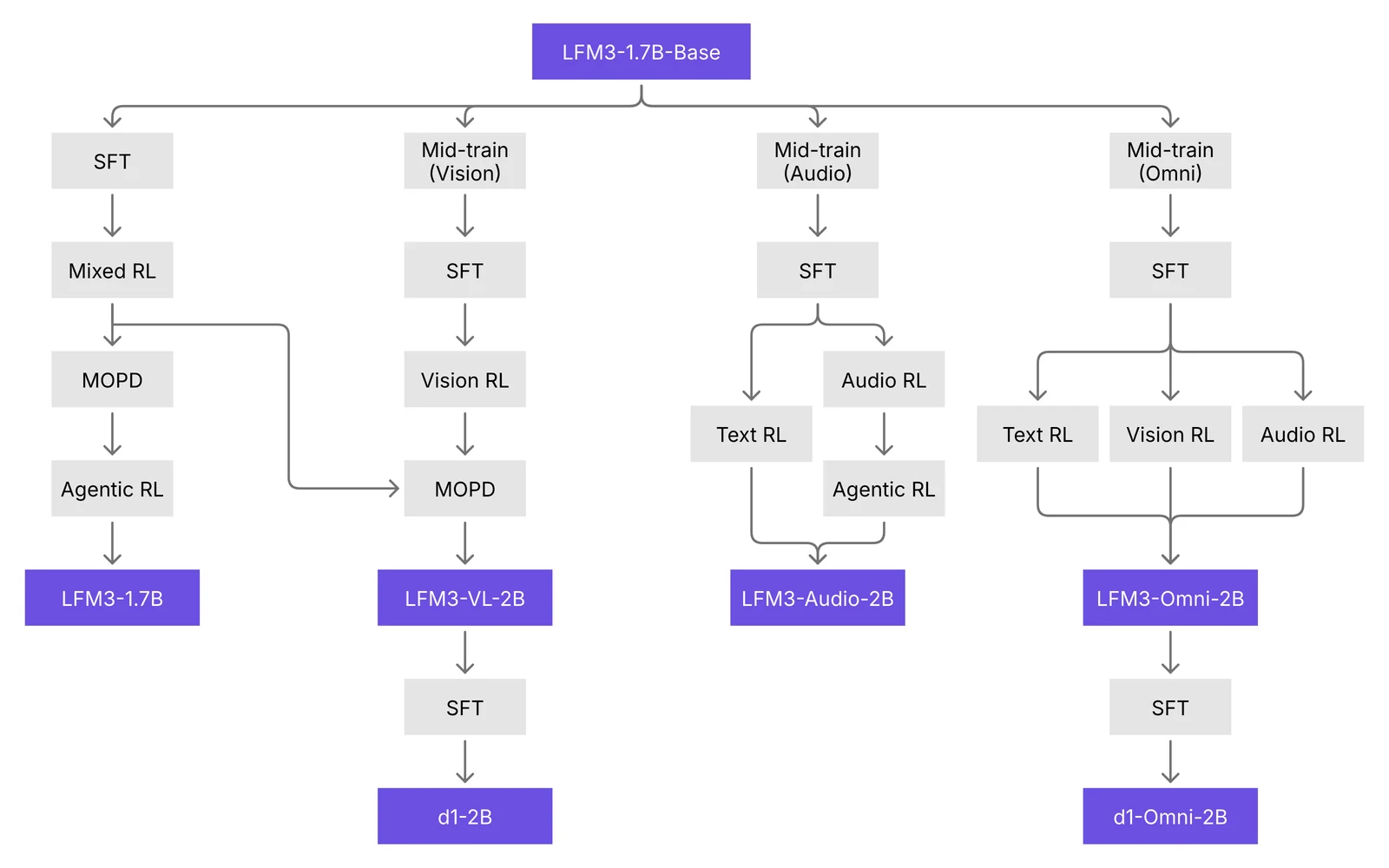
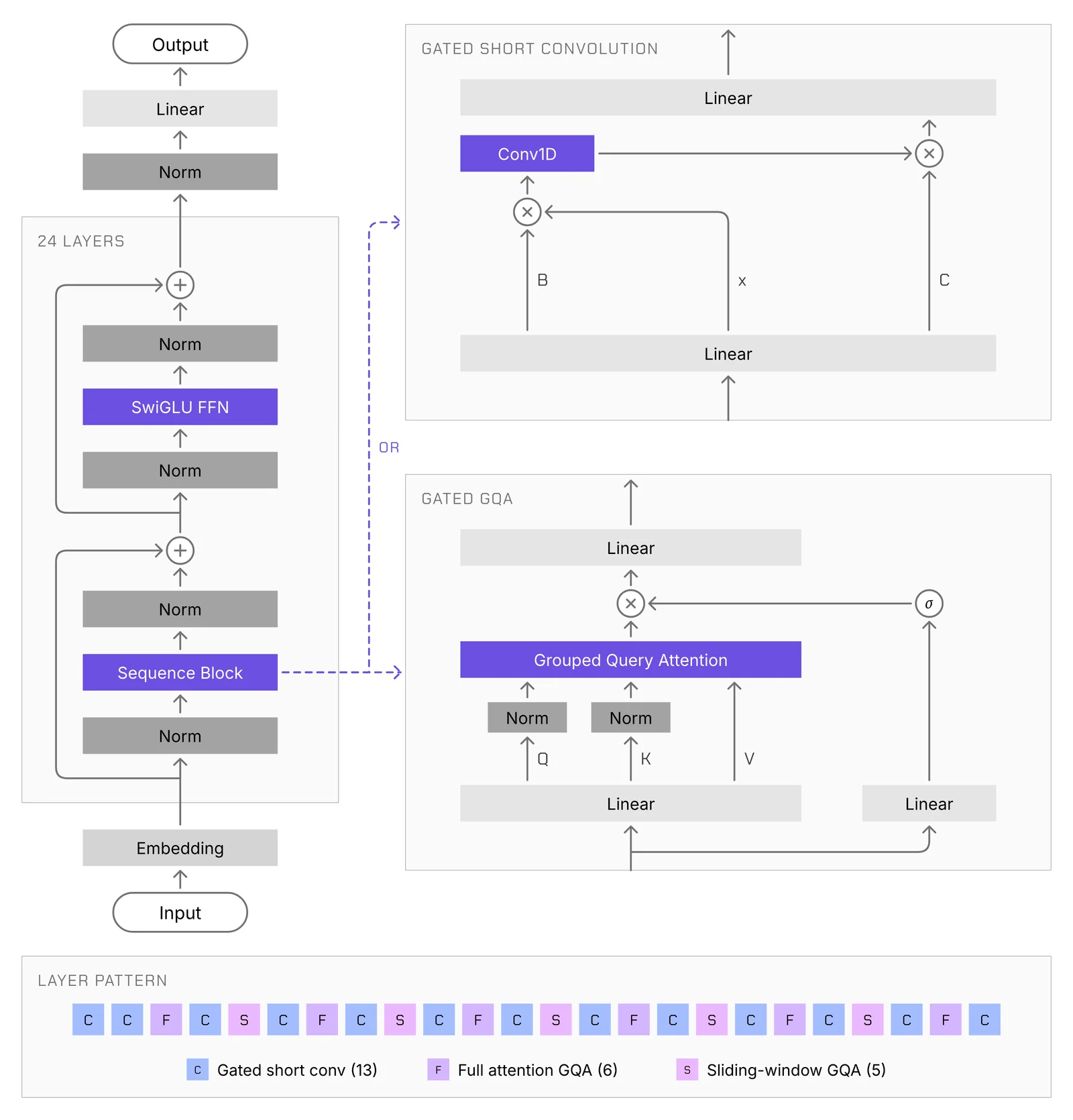
Liquid AI's technical release article describes a new combination of gated short convolutions, sliding-window attention and global attention. The 24-layer backbone contains 13 convolution layers, five local-attention layers and six global-attention layers. The company also introduces its own vision encoder and audio codec, with the family branching from LFM3-1.7B-Base.
Liquid AI reports that the text model improves on LFM2.5-2.6B with 35% fewer parameters. These are developer-reported comparisons, not measurements reproduced for this article. Our interpretation is that the shared foundation may simplify experimenting across related workloads; it does not remove the need to measure the chosen checkpoint, quantization and runtime together.
How to access and deploy the models
The official model cards provide download identifiers and checkpoint-specific loading examples. Liquid AI also links its Playground and API console; this article has not tested account access, quotas or pricing. Download availability and hosted-service terms are separate questions.
For local experiments, follow the selected card before copying a generic server command. The Transformers deployment guide explains the library's role in experimentation and direct access to model internals. Its general examples currently reference earlier LFM models, so they should not override LFM3-specific requirements. The vision card requests Transformers 5.21.0 or later; the Audio and Omni examples request 5.20.2 or later.
Backend support also varies. The vision card currently describes SGLang integration as under review and vLLM support as in progress. Omni's SGLang route is documented for text output. Those qualifications matter more than a broad library badge on a model page.
For agent integrations, the official local-agent guide describes serving an OpenAI-compatible endpoint and pointing Hermes Agent, OpenClaw or Pi at it. Its detailed model examples use earlier LFMs. Treat it as a wiring pattern, then check the current checkpoint's compatibility and tool-call configuration.
Customization, licensing and practical limits
Liquid AI's cookbook repository lists LFM3 examples for adapting visual inspection, spoken commands and spoken image questions. These examples make task-specific training more concrete than a general claim that a model is customizable. They remain starting points: a useful evaluation needs held-out examples from the actual application, including cases where the desired answer is missing or ambiguous.
The checkpoints use the LFM Open License v1.0. It permits use and redistribution subject to its conditions and contains a commercial-use limitation tied to a defined annual-revenue threshold of $10 million. Redistribution requirements include preserving notices and supplying the license. This is a custom license; a weights download should not be described as unrestricted commercial permission.
Our practical assessment is to test the smallest relevant interface first. Check task accuracy, response consistency, total memory and end-to-end latency on the intended hardware. Include media preprocessing and long inputs in that measurement. None of the results reported here represents a local benchmark or a completed deployment test.
Frequently asked questions
Is LFM3 one model or a family?
It is a family. The October 27 release covers six specialized models plus the base checkpoint used to build them. The decision variants serve a different output contract from the conversational variants.
Does LFM3-Omni generate videos?
The documented outputs are text and speech. It understands supplied video, including its soundtrack; that capability does not make it a text-to-video model.
Does every variant have 256K context?
No. That figure belongs to the text model. Audio and Omni list 32K, while the vision and decision checkpoints list 128K. Longer configured context also does not ensure reliable answers across every input length.
Which model should a developer evaluate first?
Choose by the required output: text assistance, visual interpretation, speech interaction or typed decisions. For decisions without audio, the vendor specifically favors d1-2B over its Omni counterpart. Then validate with representative data before adding more modalities.