Baidu released Unlimited OCR 2 on October 27, 2026, together with MarathonDocBench, a benchmark for parsing documents hundreds of pages long. The release targets a practical weakness of long-document OCR: keeping text, tables and other structures connected when they continue onto another page. Baidu identifies sparse visual attention as the main architectural change. Official model announcement.
The announcement concerns document transcription and structure recovery. Its significance for an archive or document-processing team depends on the complete output, including page order and table continuity, rather than a few accurately recognized paragraphs.
What changed in Unlimited OCR 2?
The original Unlimited OCR Works paper, submitted on June 22, described Reference Sliding Window Attention, or R-SWA. It constrained the decoder's text history while preserving visual references, addressing the growing attention cache that otherwise slows long outputs. That first paper discussed transcribing dozens of pages within a standard 32K maximum length. It remains the arXiv record linked by the new model card; its June date should not be mistaken for the second version's release date. Original paper and submission history.
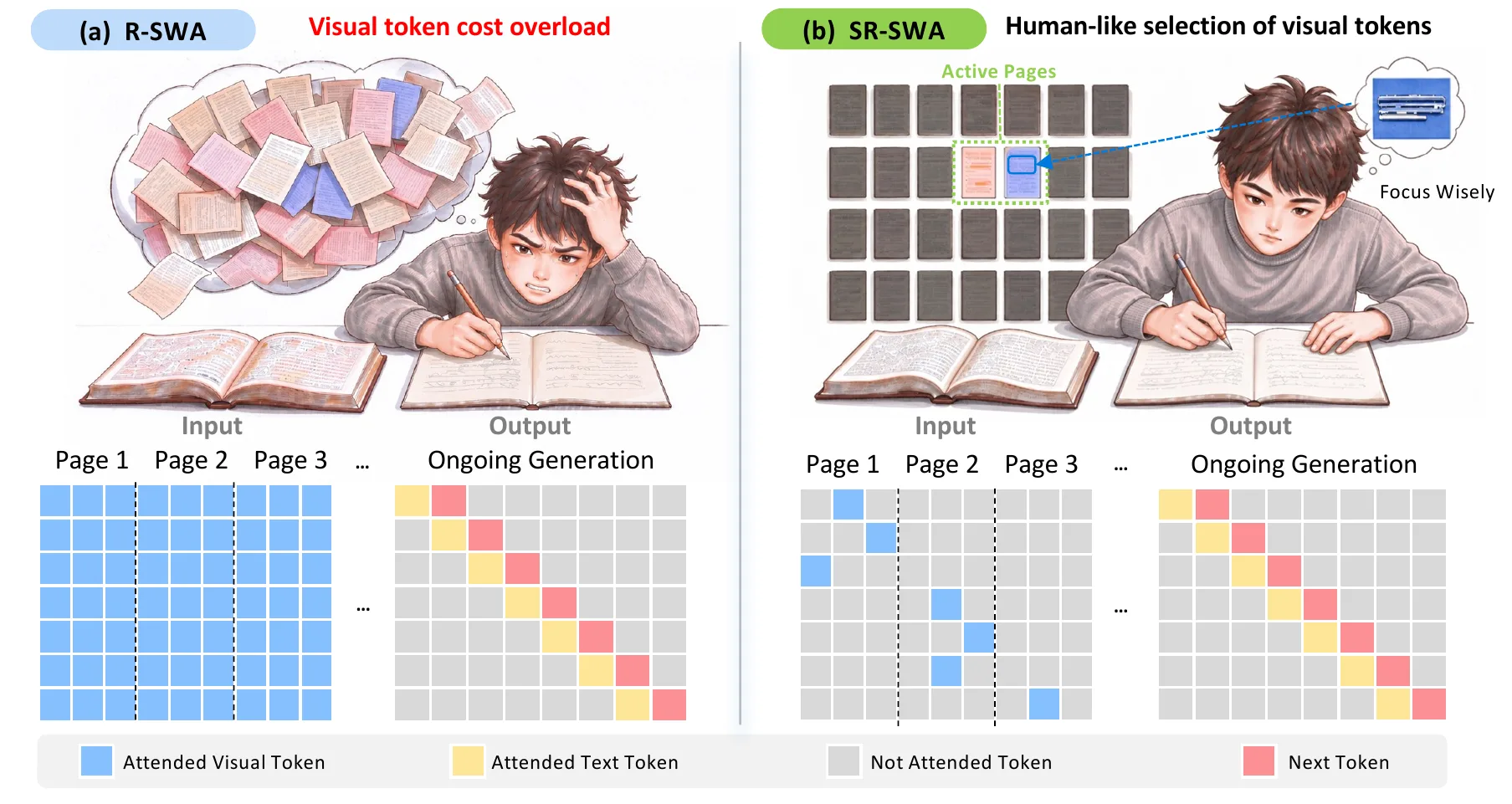
Version two introduces Sparse Reference Sliding Window Attention, abbreviated SR-SWA. The useful distinction is which visual information stays active during generation: the new design selects a bounded working set instead of repeatedly consulting every page's visual tokens.
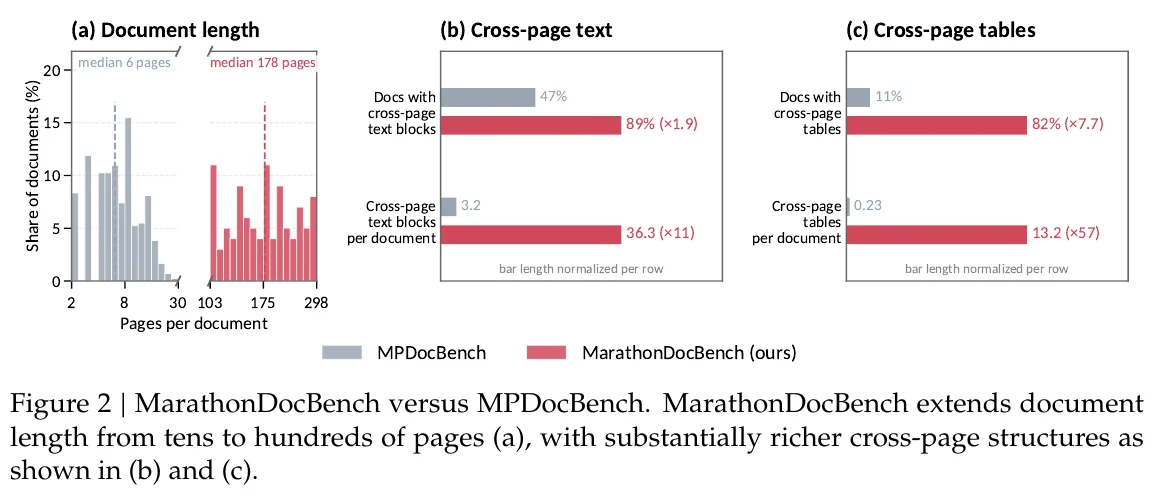
Source: Baidu technical report, Figure 2 on page 5.
Release specifications and licensing
| Item | Officially documented detail |
|---|---|
| Model identifier | baidu/Unlimited-OCR-2 |
| Architecture | DeepEncoder with a mixture-of-experts decoder; the report describes approximately 3B total parameters |
| Model configuration | BF16, 12 decoder layers and a 128-token sliding window |
| Configured position limit | max_position_embeddings: 131072; this is a configuration value, not a guaranteed PDF page count |
| Model license | MIT |
| Input and output | Ordered page images; structured layout output with page and block markers |
These details come from the published configuration, technical report, model card and post-processing documentation. Configuration fields describe this checkpoint; they are not measured throughput or minimum-hardware specifications.
How SR-SWA reduces visual attention work
Baidu's report describes two cooperating stages. PageGate narrows the relevant page-level visual references. TokenSieve ranks blocks within that candidate space and selects a fixed number for attention, alongside a local window. The goal is to keep active references bounded as the document grows. SR-SWA methodology, sections 3.3–3.4.
The official illustration above makes the intuition visible: its left panel attends broadly across page images; its right panel highlights selected regions while generation continues. Our interpretation is that this resembles copying a book while focusing on the current passage and occasionally consulting relevant material. It explains the intended attention pattern, not a claim that the model reasons like a person.
Our interpretation: bounded work per decoding step does not mean a 300-page document takes the same total time as ten pages. More pages still require image preparation and more generated output.
MarathonDocBench: results and comparison limits
MarathonDocBench contains 100 mixed Chinese/English documents, approximately 18,000 pages and 205,000 annotated layout elements. It tests content and structure, including reading order, heading hierarchy and continuations of text or tables across pages. Baidu reports 77.06 Overall for Unlimited OCR Works 2; Overall averages eight metrics. These are vendor-reported results. Dataset and leaderboard.
The evaluation produces one Markdown prediction per document using the MPDocBench toolkit. Baseline requests can encounter provider image limits, request-size limits and output ceilings; documented failures remain empty predictions, keeping the denominator at 100 documents. Consequently, the leaderboard reflects end-to-end completion under that protocol as well as recognition quality. The dataset card also distinguishes its Apache-2.0 annotations from source page images supplied for research use. Evaluation instructions and dataset terms.
For a purchasing or deployment decision, our assessment is to compare individual metric results and failed-document counts, then reproduce the comparison on representative files. An aggregate score alone cannot show whether a specific table or heading tree survived.
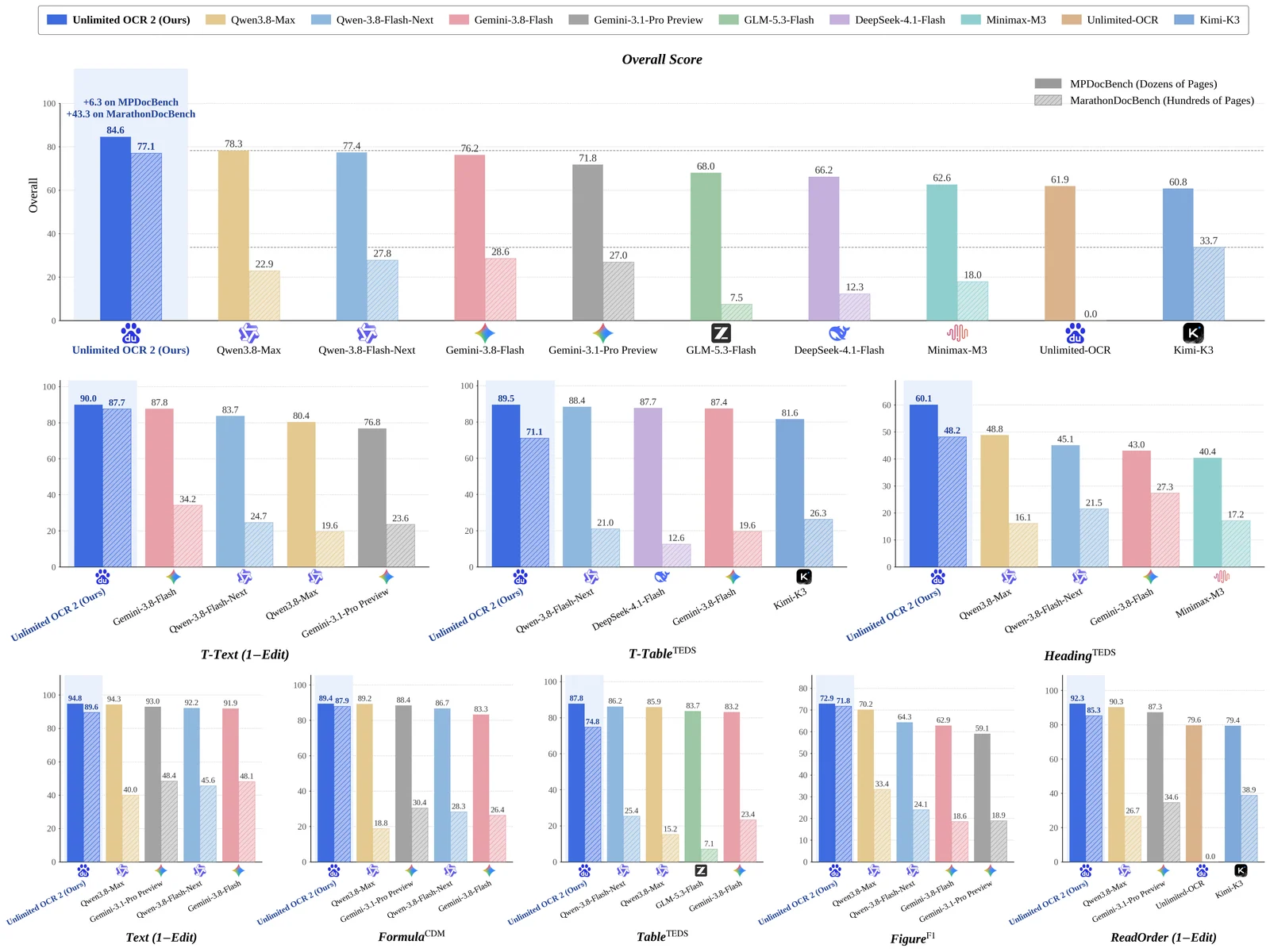
Source: Baidu model card and published performance figure.
How to access and run the release
Unlimited OCR 2 weights are downloadable from Hugging Face. Baidu documents Transformers for initial experiments and recommends SGLang for serving. Its tested Transformers environment uses Python 3.10 and an NVIDIA A800 with 80GB memory; that is a reported test setup, not a verified minimum requirement. Official inference instructions.
For deployment, use the project's customized SGLang wheel and PDF-to-image preparation instructions. The repository exposes page-window scheduling and reuses the previous window's attention-cache tail. It warns that reducing the window can lower peak memory while weakening cross-page merging. Read the current command examples before choosing settings. Serving and memory tradeoffs.
Our suggested first check is one complete document with a known cross-page table. Preserve the original page order, raw output and converted output so that a missing row can be traced to recognition, continuation handling or conversion. This is an evaluation procedure, not a result from our own model run.
Read the official output example before integrating
Unlimited OCR 2 does not directly emit ordinary Markdown. The official utility documentation shows a sequence containing <PAGE>, <BLOCK>, heading levels, bounding boxes and continuation labels. Its converter turns these into Markdown headings, HTML tables and figure references, while retaining page numbering. Raw-format example and converter usage.
The converter source also joins marked continuation chains, removes repeated table headers and normalizes heading structure. This matters when reading demonstrations: a clean rendered document represents both model output and post-processing behavior.
Our integration advice is to inspect a continuation at the page boundary in both formats. Check row counts, repeated headers, figure page numbers and heading nesting. Saving only the final Markdown makes it harder to distinguish what the model recognized from what the converter reconstructed.
Where the release may fit, and where to be cautious
For Unlimited OCR 2, our assessment is that the strongest evaluation candidates are long reports, manuals and research compilations where tables or paragraphs cross page boundaries. Teams already splitting every page into isolated OCR jobs have a clear comparison to make: does document-level parsing reduce the repair work needed to reconnect the result?
Baidu's report acknowledges limited training-data diversity and weak preservation of global document information, especially heading hierarchies. Limitations, section 6. Our inference is that a pipeline requiring a reliable document outline should validate that structure separately rather than assuming accurate text implies accurate hierarchy.
For a short, clean document, the operational work of a custom serving stack may outweigh any long-document advantage; that is a deployment tradeoff to measure. For high-consequence records, compare the extracted content with the source pages and retain a review step. None of the published results establishes error-free extraction for an unfamiliar document collection.
Unlimited OCR 2 FAQ
Is the release free to use commercially?
The model card identifies MIT licensing. The repository's MIT terms permit commercial use, modification and distribution while requiring preservation of the copyright and permission notice. They also provide the software without warranty. Downloadable weights do not remove compute or hosting costs. Dataset source-image rights are a separate question. Official license.
Does Unlimited OCR 2 remove every document limit?
No. It describes the approach to extending parsing through bounded working references and sequential decoding. Available memory, page preparation, output limits and serving configuration still affect a real run. Treat successful completion of your longest representative files as an acceptance check, not an implication of the name.
Can I feed the raw output straight into a Markdown viewer?
Use the official conversion step first. The layout markers carry structure that an ordinary Markdown renderer will not interpret. Keep the raw version alongside the converted document when checking whether a cross-page paragraph or table was joined correctly. Official conversion workflow.